
Case Study: How a Ski Chalet Business Went From 1.2x to 32.7x ROAS by Tracking Real Bookings
By AdAudit Pro ·
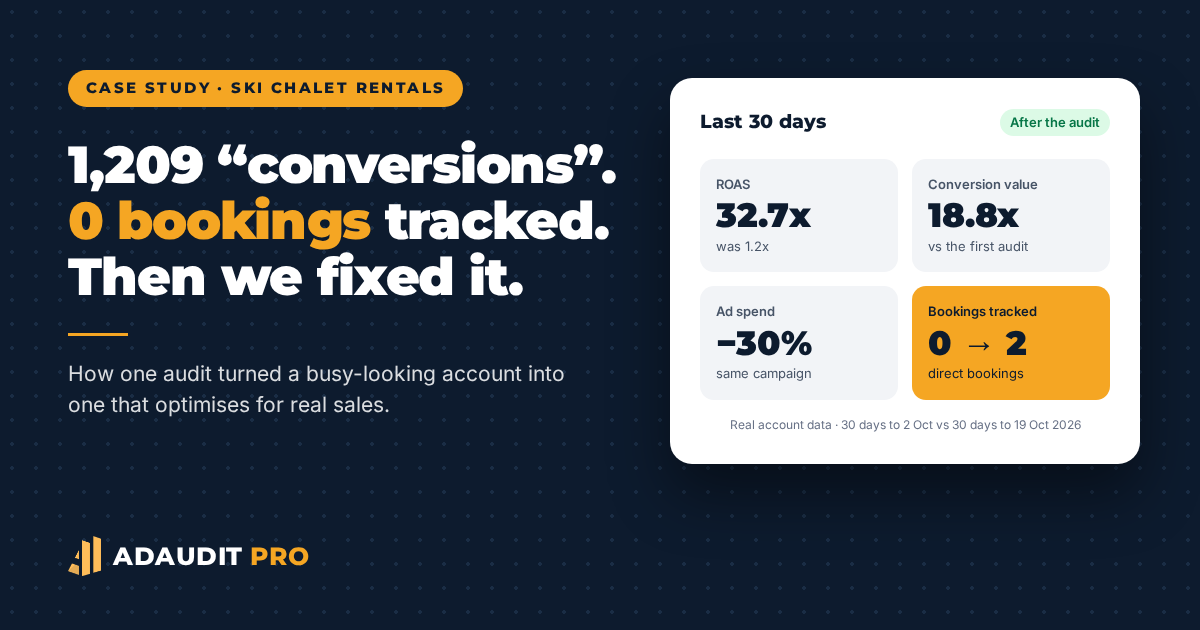
Our headline says “Don’t optimise for scores. Optimise for sales.” This case study shows what that means in a real account.
The client is a ski chalet rental business in the Pyrenees. They run their own Google Ads, with one main Search campaign bringing skiers to their website, where guests can book a stay. When they ordered their first AdAudit Pro report, the account looked healthy on the surface. It had a strong click-through rate, cheap clicks and well over a thousand conversions a month.
The problem was that none of those conversions were bookings.
The Results at a Glance
| Last 30 days | First audit (to 2 Oct 2026) | Re-check (to 19 Oct 2026) | Change |
|---|---|---|---|
| Return on ad spend (ROAS) | 1.2x | 32.7x | 27x higher |
| Conversion value | baseline | 18.8x the baseline | +1,781% |
| Ad spend | baseline | about 30% less | −30% |
| Clicks | 1,609 | 758 | −53% |
| Bookings tracked in Google Ads | 0 | 2 | from zero |
All figures come straight from the client’s Google Ads account, as recorded in our two reports. We have left out currency amounts to protect the client’s privacy.
What the Account Looked Like Before
On paper, the campaign was doing well. In the 30 days before our first report, it recorded 1,209 conversions from 1,609 clicks. That is a 75% conversion rate, which is far higher than any real booking site achieves.
When we looked at the conversion setup, the reason was clear. Almost every conversion was a click through to the separate booking website, not a booking. The actual purchase conversion existed, but it had recorded zero bookings in 30 days. Each “conversion” was valued at less than one unit of currency, so the account showed a ROAS of just 1.2x.
The campaign was set to Maximise Conversions. In practice, that told Google: “Find me more people who click a button.” And that is exactly what Google did. It found clickers, not guests.
What Our First Audit Found
The report ranked five issues by their impact on the business:
- Urgent: booking tracking did not look trustworthy. The account counted button clicks as conversions, while real bookings were not being recorded. Every bidding decision was based on the wrong signal.
- Important: keyword targeting was too broad and too mixed. Broad keywords were matching searches that had little to do with booking a ski chalet.
- Important: the Search campaign was also spending on the Display Network. Part of the budget was going to banner placements instead of people actively searching.
- Important: the budget was running out before the account was under control. Money was being spent on loose targeting while better searches went unserved.
- Important: the ads and landing page did not closely match what people searched for.
Each issue came with plain-English evidence, why it mattered and a step-by-step fix the owner could do without an agency.
What the Owner Changed
The owner worked through the action plan over the following weeks. Google Ads keeps a change history, so we can see exactly what was done:
- Fixed the tracking. The purchase conversion from Google Analytics was set up properly and made a primary conversion, so Google Ads could finally see real bookings and their value.
- Rewrote the ads. Headlines, descriptions and final URLs were updated to match the searches more closely.
- Cleaned up the keywords. Weak ad groups were paused and loose keywords were removed.
- Added ad assets to give the ads more space and information in the results.
- Switched the bidding to Maximise Conversion Value, so Google now aims for booking value instead of the number of button clicks.
- Turned off the Display Network on the Search campaign, so the budget only goes to people searching on Google.
None of these changes required new software, a bigger budget or an agency. They were all settings the owner already had access to.
The Results
Our re-check covered the 30 days to 19 October 2026. In that period:
- ROAS went from 1.2x to 32.7x. For every unit spent on ads, the campaign now returns 32.7 in tracked booking value.
- Conversion value grew 18.8 times, while ad spend fell by about 30%.
- Clicks halved, from 1,609 to 758. That is not a bad thing. With the right signal, Google stopped chasing cheap clickers and started bidding on searches more likely to book. The average cost per click rose a little, which is normal when you compete for better traffic.
- Two direct bookings were tracked, compared with zero before. For a chalet business, each booking is a high-value stay, which is why two bookings make such a difference to ROAS.
Why Fewer “Conversions” Is Good News
In the re-check period, the account recorded 468 conversions instead of 1,209. If you only looked at the conversion count, you might think performance had dropped by more than half.
It is the opposite. The old number was inflated by button clicks. The new number sits next to real bookings with real value, and that value is what pays the bills. This is the trap our audit is designed to catch: an account that scores well on the metrics Google shows you but does not bring in sales.
Being Honest About What Comes Next
We want to be clear about what these results do and do not show.
- It is early days. Two bookings is a small number, and the ski season is only just starting. One more or one fewer booking would move ROAS a lot. The trend matters more than the exact figure.
- The tracking is better, but not finished. Our re-check still flags that Google Ads and Google Analytics count conversions differently, and that a checkout conversion is set as primary but has not recorded anything yet. Fixing this will give Smart Bidding an even cleaner signal.
- There is plenty of room to grow. The campaign shows ads for only about 13% of the searches it could appear for. About 66% of the possible impressions are lost to ad rank and about 21% to budget. Now that the account measures bookings properly, the owner can raise the budget with much more confidence.
That is why every AdAudit Pro report includes a free re-audit. The first report finds the leaks. The re-audit checks the fixes worked and shows what to do next.
Lessons for Any Small Business Running Google Ads
- Check what your conversions actually are. Open Goals > Conversions in Google Ads and look at which actions are set as primary. If they are button clicks, page views or form starts, Google is optimising for those, not for sales.
- A very high conversion rate is a warning sign, not a win. If more than a third of your clicks “convert”, something is probably being counted that should not be.
- Give conversions a value. Value-based bidding can only work if Google knows what a sale is worth.
- Keep Search campaigns on Search. Untick the Display Network unless you have a clear reason to use it.
- Judge results by sales, not scores. Optimisation Score, conversion counts and click-through rate are only useful if they lead to revenue.
How AdAudit Pro Helped
The owner did not hire an agency. They ordered one All-in-One Audit, which connected to Google Ads and Google Analytics in read-only mode. The report found the tracking problem, ranked it as urgent, explained it in plain English and gave the exact steps to fix it. A specialist reviewed the findings before the report was released.
If your account shows lots of conversions but your bookings, sales or enquiries do not match, there is a good chance the same problem is costing you money.
Frequently Asked Questions
Is this a real account?
Yes. All figures come from the client’s own Google Ads account, as recorded in our first report (30 days to 2 October 2026) and the re-check (30 days to 19 October 2026). We have kept the client anonymous and left out currency amounts.
Did AdAudit Pro make the changes in the account?
No. AdAudit Pro has read-only access and never changes anything. The owner made every change themselves by following the action plan in the report.
Will I get the same results?
Not necessarily. Every account is different. This account had one large problem (it counted button clicks instead of bookings), and fixing it had a big effect. Your report will show which issues matter most in your own account.
How do I know if my conversion tracking has the same problem?
A conversion rate far above what your business really achieves, or a big gap between conversions in Google Ads and actual sales, are common signs. Our audit checks your conversion actions, which ones are primary and whether Google Ads and Google Analytics agree.
Is Your Account Counting Clicks Instead of Sales?
Get your All-in-One Audit for £55. Read-only access, no contract, and a specialist-reviewed report showing exactly what to fix first.
Figures come from the client’s Google Ads account as recorded in AdAudit Pro reports dated 3 October 2026 and 20 October 2026, each covering the previous 30 days. Results vary by account. AdAudit Pro is a trading name of George Own Ltd.